· rreck · 6 min read
What They Took Out, and Put Back: A Clause Timeline of Three Terms of Service
Terms of service are revised for two decades, and clauses come and go. Scoring every archived revision of YouTube, Reddit, and Twitter against the same 34 consumer issues — and measuring how much each revision changed — surfaces what a single snapshot hides: rewrites that leave the length untouched, and clauses removed for years that quietly return. YouTube's terms drop machine-learning language in the 2010s and bring it back, spelled out, in July 2022 — a revision that replaced 92% of the document's wording with a net length change of 21 words.
Abstract
A terms-of-service document is a moving target. The version you agreed to is one frame of a film that runs for twenty years, and clauses enter and leave across revisions. This analysis reconstructs the revision history of three agreements — YouTube’s, Reddit’s, and Twitter’s — from the Wayback Machine, measures how much each revision changed, and scores every usable revision against the same catalog of 34 consumer issues to ask a question a single snapshot cannot answer: which clauses were removed and later brought back? Everything runs on-premises. The headline case is concrete: YouTube’s terms carry no meaningful machine-learning language for most of the 2010s and reintroduce it, explicitly, in the July 2022 rewrite — a revision that replaced 92% of the document’s wording while changing its length by 21 words.
Why a snapshot is not enough
An earlier post measured terms of service at a single moment — scoring each document against a fixed catalog of issues and ranking them by what they cover. That treats the current version as the object of study. But a current version is an accident of when you looked. A clause that is absent today may have been present for a decade; a clause that reads as new may be a restoration of language that was quietly dropped and is now quietly back.
To see that, you have to score the whole history, not the latest frame.
The revision record
The histories come from the Wayback Machine, sampled at two captures a year from each document’s earliest snapshot — the provenance engine fingerprints every revision, so the share of each revision’s wording that is genuinely new (versus carried forward from any earlier revision) is measured, not estimated. Three classes of junk capture are excluded automatically: application shells (the live youtube.com/t/terms today serves a 291-word JavaScript shell), localized captures (Twitter’s 2015 snapshots are full-length documents in another language, sharing 0.3% of their fingerprints with every English revision), and holding pages.
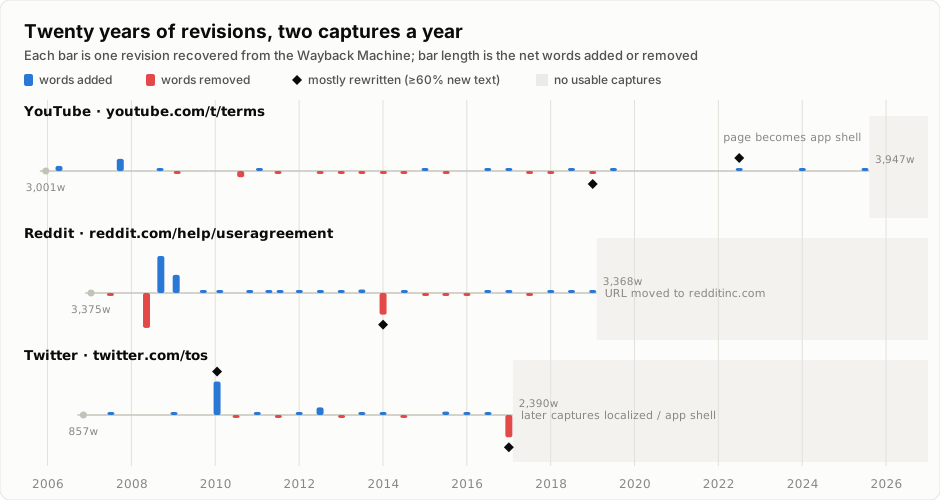
Each bar is one revision — up for words added, down for words removed; a diamond marks a revision that replaced at least 60% of the wording. Two things stand out. First, terms grow: Twitter’s ran 857 words in 2006 and 2,390 by 2017; YouTube’s went from 3,001 to 3,947. Second, length is a poor signal of change: Reddit’s agreement ends its 2007–2019 span within seven words of where it started while 83% of its wording was replaced in one January 2014 revision, and YouTube’s July 2022 rewrite is the extreme case — 92% new wording, net +21 words. Five major rewrites across three documents in two decades; everything else is accretion. All three lineages also end the same way: the document outlives its address (Reddit’s moved to redditinc.com in 2019; Twitter’s stopped serving usable English captures after early 2017; YouTube’s URL now returns a shell) — which is why long-horizon tracking has to follow a succession of URLs, not one.
The clause measurement
Each usable revision’s sentences are embedded with the all-mpnet-base-v2 model into 768-dimension vectors, and each of the 34 issues is matched against them exactly as in the coverage audit: an issue is present in a revision when the document’s language clearly carries it. The result is a grid — 34 issues down, one column per revision across time — where a filled cell means the clause was in that version. This pass scored 75 archived revisions: YouTube (36 captures, 2005–2025), Reddit (24, 2007–2019), and Twitter (15, 2010–2017).
From the grid, three events are derived per issue: when it first appears, when it drops, and when it is brought back. A drop only counts as a genuine restoration if the clause was absent for two or more consecutive revisions before returning. That threshold matters, and the reason is the next section.
The trap: bad captures look like edits
Web archives are not clean, and scored naively, a bad capture registers as though every clause vanished at once and reappeared at the next good capture — a mass “edit” that never happened. Beyond the fingerprint-level gates above, a second defense operates at the clause level: a capture is flagged unusable when it matches too few of the 34 issues to be a real agreement. Of the 75 revisions, 66 are usable and 9 are flagged. And the read itself matters: when many clauses appear to drop and return on the same two dates, that is a capture artifact, not a rewrite. Twitter shows exactly this — five unrelated clauses all “leaving” in July 2012 and “returning” in July 2015 — the signature of one odd capture in between, not five coordinated edits.
The signal that survives scrutiny is a single clause moving on its own.
What actually came back
The clearest case is YouTube and machine learning. Early YouTube terms touch on automated use of content; the language then thins out through the 2010s and is effectively absent for years. In the July 2022 revision it returns, now explicit about how uploaded content may be processed — and the fingerprint record independently identifies that same revision as YouTube’s largest rewrite (92% new wording). One issue, moving once, in a revision independently known to be a major overhaul.
Reddit shows a smaller, cleaner example. The right to delete your account — a user-protective clause — is present early, drops out around 2009, and is restored by 2014, where it has remained. A clause that works in the user’s favor was gone for years before it came back. The restoration lands in the same January 2014 revision the fingerprint record flags as Reddit’s one major rewrite.
Across all three documents, the counts are modest and honest: after filtering capture noise, YouTube has five clauses that were dropped and restored, Twitter five (mostly the 2012–2015 artifact, visible and discountable), and Reddit two. The point is not that terms of service churn wildly. It is that they churn at all, in specific and traceable ways, and that the direction of a change — toward the company or toward the user — is legible once you score the whole timeline instead of one frame.
Numbers
| YouTube | |||
|---|---|---|---|
| Archive requests for full history | 42 | 25 | 26 |
| Revisions scored against issues | 36 | 24 | 15 |
| Words, first → last usable capture | 3,001 → 3,947 | 3,375 → 3,368 | 857 → 2,390 |
| Major rewrites (≥60% new wording) | 2 | 1 | 2 |
| Clauses dropped and restored | 5 | 2 | 5* |
* mostly one 2012–2015 capture artifact, visible in the grid and discountable.
On-premises, at fixed cost
Scoring 75 revisions is 75 documents’ worth of embedding, and the corpus this belongs to is growing toward thousands. None of it incurs a per-call fee or sends a clause to an outside service: the model runs locally, and the cost of the analysis is the cost of the machine it already runs on. For work that consists of reading other people’s contracts at scale, keeping the text and the computation in-house is the design, not an option.
Where it goes next
The same timeline can be built for every document in the growing corpus — terms and privacy policies across dozens of companies — turning a handful of case studies into a systematic record of what the industry adds, drops, and restores over time. The coverage-audit leaderboard accompanies this series; the next measurement is direction — scoring each change as moving toward the company or toward the user.