Tag: text-analytics

  • The Search for EULA Eve
    · rreck · data

    The Search for EULA Eve

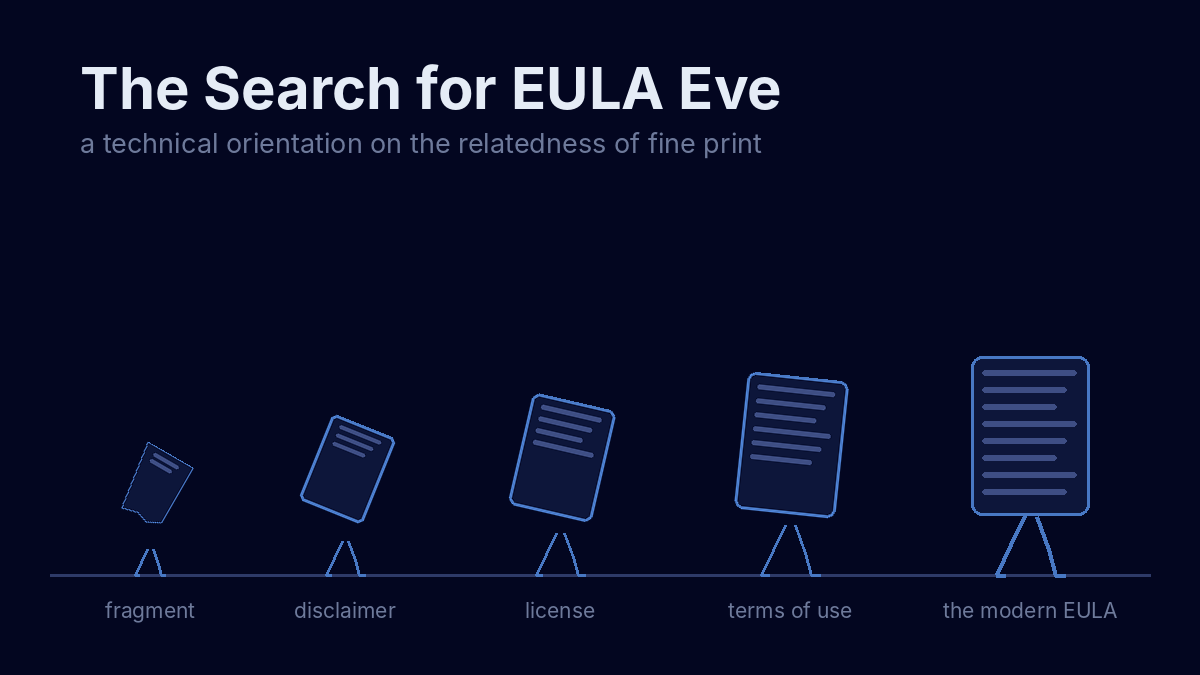
    Population genetics has Mitochondrial Eve: the ancestor every living human's mitochondrial DNA traces back to. Fine print has an equivalent question. Legal text is almost never written fresh — it descends. This is a technical orientation on measuring that relatedness: content hashes for identity, winnowing fingerprints for inherited wording, on-prem SLM embeddings for kinship of meaning, and a dated derivation graph for descent — across 6,738 documents and 125,295 clauses. The search for the common ancestor turns up something real: the warranty disclaimer, carried by nearly every license measured.

  • Considerations in data sovereignty
    · rreck · data

    Considerations in data sovereignty

    Data sovereignty means continuing, revocable control over data about yourself. A measurement of 5,791 current agreements, 861,316 policy snapshots across 22 years, and 19 before-and-after GDPR pairs shows the mobile-app EULA is engineered to make that control impossible: postgraduate prose, terms that can be rewritten silently, no version to cite, and no way to say no.

  • Readability Score Distributions Across Project Gutenberg: A 2026 Extension

    Readability Score Distributions Across Project Gutenberg: A 2026 Extension

    In 2007, Reck & Reck computed seven readability measures for 15,511 Project Gutenberg texts and characterised the distribution of each across the corpus. This work extends that study to the present corpus — 60,787 English-prose works, the seven measures, lexical and structural features, lexicon-based sentiment, and emotional arcs — with author metadata drawn from Wikidata and an interactive tool for exploring any author against the whole distribution.

  • Written to Be Agreed To, Not Read
    · rreck · data

    Written to Be Agreed To, Not Read

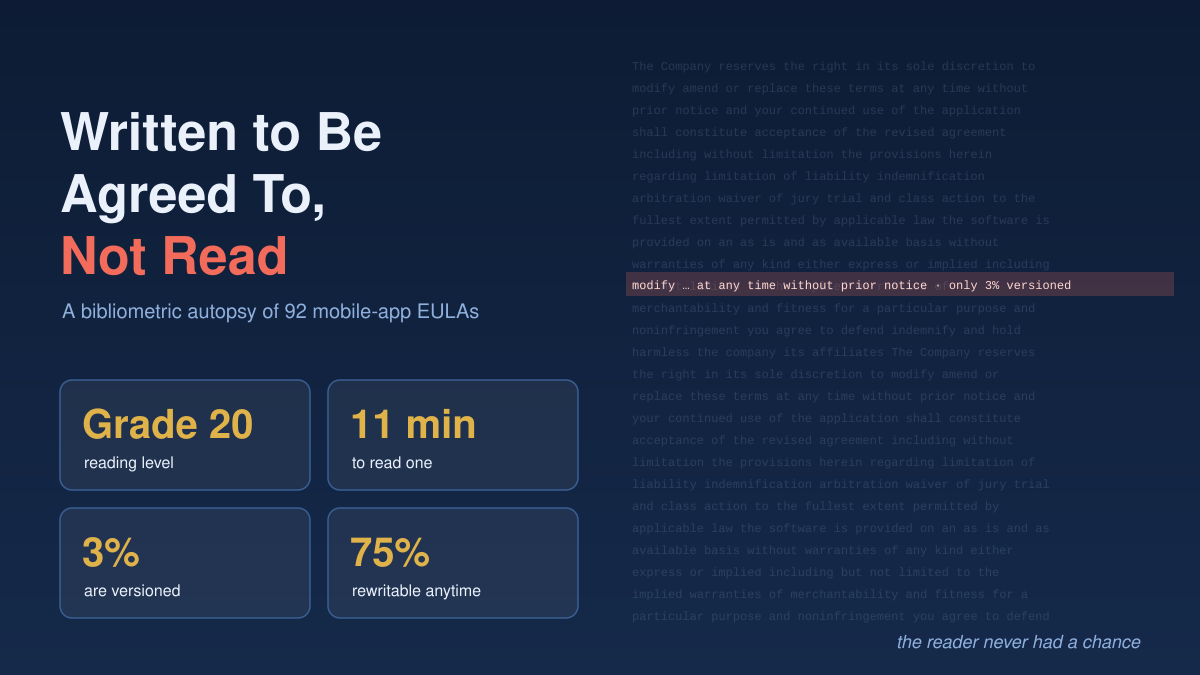
    In 2013 a draft paper set out to measure the mobile-app agreements nobody reads, then stalled with its statistics left as 'XX' placeholders. This finishes it. A bibliometric analysis of 92 real mobile-app EULAs finds a postgraduate reading level, ~11 minutes each, and a structural trap: three-quarters can be rewritten at any time and bind you by 'continued use,' yet only 3% carry a version number. The agreements are written to be agreed to, not read — with the fine print, verbatim, to prove it.